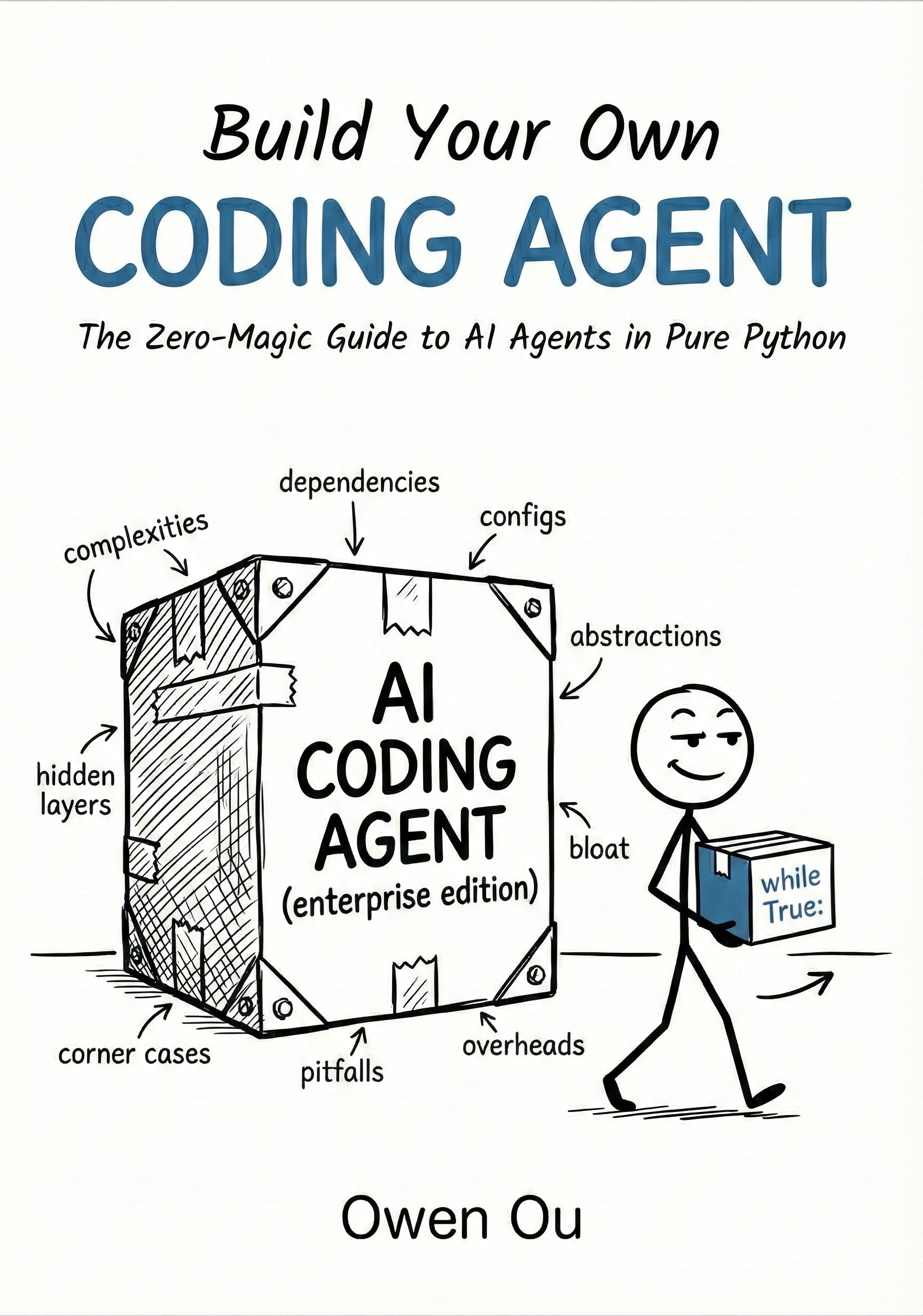
You've tried the frameworks. You've watched your LangChain app hallucinate its way into disaster. There has to be a better way.
Build Nanocode — a production-grade AI coding agent — from scratch.
Pure Python. Under 700 lines. Code you can debug with print().
An agent is just four things. You'll build each one from scratch.
A stateless API call — Claude, DeepSeek, or Ollama
Read, write, and surgically edit files. Execute shell commands. Search code and the web.
A Markdown scratchpad injected as the system prompt. Persists across sessions.
A while True that runs tools, self-corrects errors, and asks permission before dangerous ops.
The Final Exam: In Chapter 12, the agent builds a complete Snake game in Pygame — without the user writing a single line of code.
You speak the plan. The agent writes, runs, debugs, and fixes the code until the game is playable.
From "Hello World" to a game-building AI — one chapter at a time.
Part I — The Brain
Part II — The Hands
Part III — The Frontier
No. If you can write Python, you can follow this book. Every AI concept is explained from scratch with physical metaphors — no math, no theory papers.
The book covers Claude, DeepSeek, and Ollama. The Adapter Pattern (Chapter 4) makes adding new providers trivial — you'll understand exactly how to wire up any LLM API.
No. By Chapter 12, your agent builds a complete Pygame game autonomously. The architecture handles real files, real shell commands, real errors — with safety modes and persistent memory.
Python 3.10+ and three dependencies: requests, python-dotenv, and pytest. That's it.
Yes. You'll build a FakeBrain test double that lets you run full pytest suites instantly — verifying complex agent logic without making a single API call.
Yes. The complete source code for every chapter is available on GitHub. Each chapter has a runnable snapshot so you can jump in at any point.